
Steve Curtis- Behind Enemy Lines
Steve Curtis | September 8th, 2026
This week, I’m launching “Behind Enemy Lines,” a weekly series introducing Oklahoma’s next opponent before our full game preview later in the week.
The Sooners will travel to Ann Arbor on Saturday for their first major test of the 2026 season.
Michigan’s season opener provided the first look at the team waiting for them.
Michigan opened the game with an 11-play, 75-yard drive capped by a one-yard touchdown run from Bryce Underwood.
It remained the Wolverines’ only score until the final play.
After four Western Michigan field goals gave the Broncos a 12-7 lead, officials restored one second to the clock after initially ruling the game had ended.
Given one final snap, Underwood found JJ Buchanan for a 47-yard touchdown, allowing Michigan to escape with a 13-12 victory.
The touchdown completed an otherwise uneven offensive performance.
Michigan finished with 276 yards, converted three of its 10 third downs and committed nine penalties for 80 yards.
Underwood completed 12 of 23 passes for 170 yards, one touchdown and one interception while losing a fumble, accounting for two of Michigan’s three turnovers.
According to Pro Football Focus (PFF), five of Underwood’s 26 dropbacks produced turnover-worthy plays. Four came when Western Michigan did not pressure him.
That distinction matters.
Underwood was not simply making mistakes because the offensive line collapsed around him. He struggled from clean pockets, particularly on short and intermediate throws, while holding the ball for an average of more than three seconds.
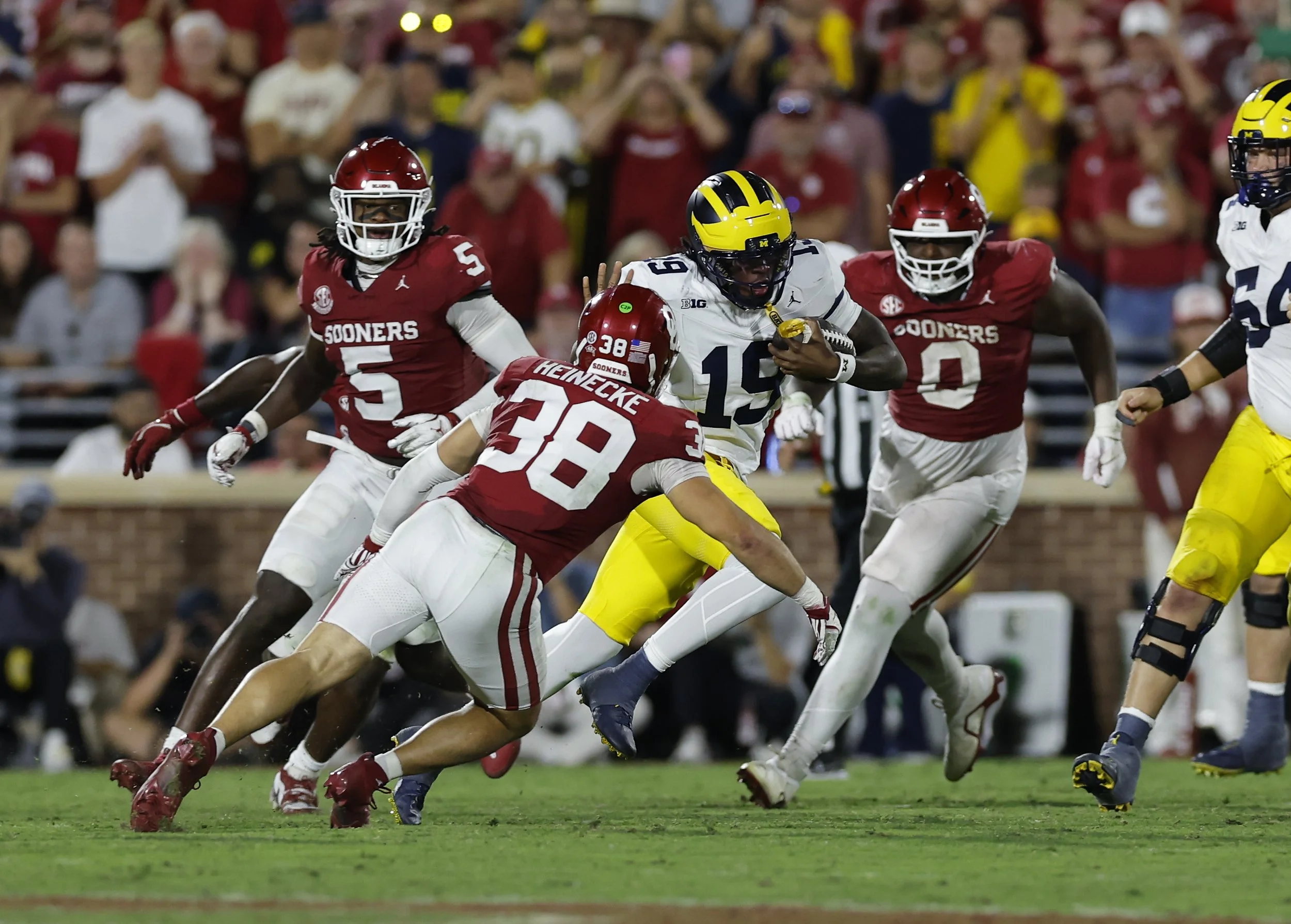
Still, his athleticism provides something Michigan can build around.
Underwood carried the ball eight times for 50 yards. Two of those carries came on scrambles that gained 22 yards, showing his ability to create when passing plays break down.
Buchanan provided the other encouraging sign.
The Utah transfer caught six passes for 126 yards and the winning touchdown, accounting for more than half of Michigan’s completions and nearly three-quarters of its passing yards.
He worked primarily from the slot and received nine targets. No other Michigan receiver caught more than two passes or produced more than 15 yards.
The running backs did not provide much help.
Jordan Marshall and freshman Savion Hiter combined for 59 yards on 16 carries. Michigan’s offensive line struggled to create movement inside, with its two runs through the middle producing two yards.
The left side was more dependable.
Left tackle Blake Frazier did not allow a pressure across 25 pass-blocking snaps, and Michigan gained 40 yards on seven runs toward the left end. The Wolverines were much less effective running toward the right or through the interior.
While the offense spent most of Saturday searching for answers, the defense kept Michigan alive.
Western Michigan gained 221 yards on 67 plays and averaged 3.3 yards per snap. The Broncos reached Michigan territory repeatedly but never found the end zone, settling for four field goals.
Michigan’s defensive ends drove that performance.
Dom Nichols recorded four pressures, two sacks and seven defensive stops while earning the highest overall grade on the defense, according to PFF. Utah transfer John Henry Daley added two pressures in his first game since suffering a torn Achilles last season.
Nichols and Daley give Michigan a dangerous pairing off the edge. Behind them, defensive tackles Enow Etta and Trey Pierce were much more effective against the run than as pass rushers.
That trend extended to the linebackers.
Troy Bowles and North Dakota State transfer Nathaniel Staehling combined for 19 tackles and consistently limited Western Michigan’s running backs after contact.
The secondary allowed 15 completions on 19 attempts, but those throws produced only 89 yards. Returning corner Jyaire Hill and Utah transfer Smith Snowden give Michigan experience outside, while Zeke Berry handles most of the work in the slot.
Taken together, Michigan’s opener revealed a team being carried by its defense.
The Wolverines have legitimate pass rushers, dependable run defenders and enough experience in the secondary to keep games close. Their offense, however, remains difficult to trust after relying on one receiver, struggling to run the ball and turning it over three times against Western Michigan.
Underwood’s final throw showed why Michigan remains committed to developing him.
But that commitment is not unconditional.
“He’s our QB right now,” Whittingham said Monday. “It’s not something that’s infinite.”
Whittingham added that Underwood’s job, like every other position, is not “absolutely set in concrete.” Michigan needs to see improvement and a level of play it believes it can win with.
For now, Whittingham said Michigan will stay the course. Saturday against Oklahoma will provide Underwood’s first opportunity to show the progress his coach expects.