
Steve Curtis - Behind Enemy Lines: Mississippi State
Steve Curtis | October 21st, 2026
Oklahoma will travel to Starkville on Saturday facing former offensive coordinator Jeff Lebby, whose Mississippi State offense could look different depending on who’s available.
The Bulldogs opened 4-0 before consecutive losses to Alabama and LSU. Injuries to quarterback Kamario Taylor and running back Fluff Bothwell have since complicated an offense that had shown it could win through the air and on the ground.
Their availability remains uncertain.
But Mississippi State’s first six games have established what those players give the offense, how it changes without them and where Oklahoma can challenge either version.
That starts with the relationship between the running game and play action.
Bothwell gives Mississippi State a back capable of carrying possessions without requiring the quarterback to create every successful play.
He rushed for more than 100 yards against Minnesota, South Carolina and Missouri before suffering an injury late against Missouri.
Bothwell had become a dependable part of the offense against stronger competition, not simply a beneficiary of the season-opening rout of Louisiana-Monroe.
His contribution also extends beyond the handoff.
Bothwell can release out of the backfield and provide an available throw when defenders take away the receivers downfield. His return would restore both a dependable runner and another passing option.
Without him, Kolin Wilson, Xavier Gayten and J.J. Hill give Mississippi State alternatives.
The Bulldogs have still found productive carries with that group. They haven’t shown the same ability to build a complete offense around them.
That matters because the running game helps create Mississippi State’s more dangerous passing opportunities.
Taylor has repeatedly used play action to attack beyond the underneath coverage. According to Pro Football Focus (PFF), those throws produced most of his passing yardage against Minnesota and Missouri.
Defenders who step toward the handoff leave space behind them. Taylor has shown he can make those reactions costly.
But he doesn’t need play action for every productive throw.
Taylor threw 14 touchdowns during Mississippi State’s unbeaten start, distributing the ball among receivers who threaten different parts of the field.
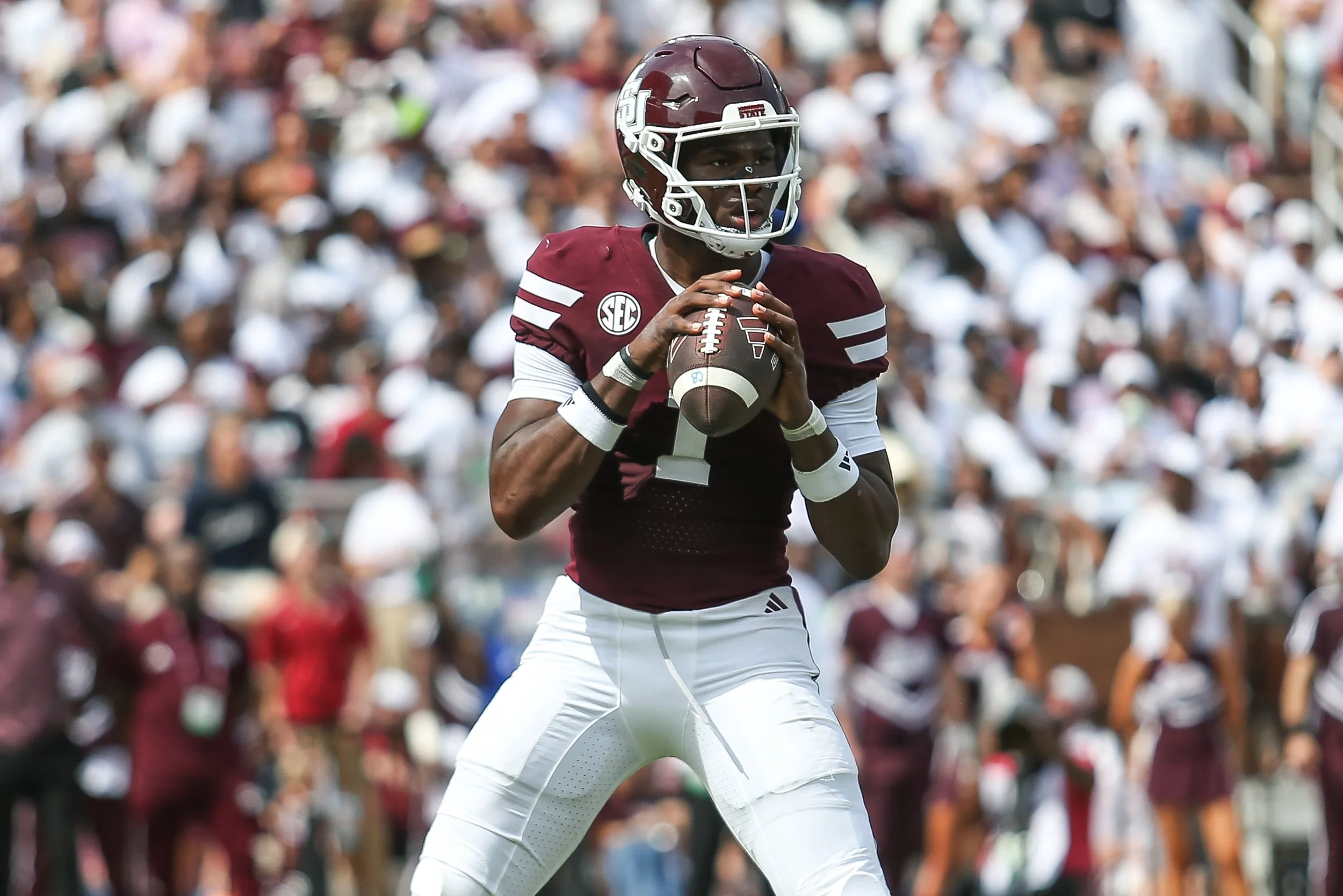
Mississippi State quarterback Kamario Taylor (1) looks downfield against Alabama during the first half of an NCAA college football game in Starkville, Miss., Saturday, Oct. 3, 2026. (AP Photo/James Pugh)
His return would give Oklahoma more to defend than the short passing game the Bulldogs have since leaned on with freshman Parker Puckett.
It wouldn’t eliminate Mississippi State’s vulnerability to pressure.
Taylor’s worst stretches have come when defenders disrupt the pocket and force him away from the available throw. Against Alabama, all three of his touchdown passes came from clean pockets. Both interceptions came under pressure.
Oklahoma must make him uncomfortable without giving him somewhere to run.
Taylor’s legs provide another way to extend possessions. A covered receiver doesn’t finish the play if the rush leaves an opening.
The same applies to Puckett.
He has shown he can contribute as a runner, but his passing production has been much more limited.
With Puckett, Mississippi State has relied more heavily on short completions, screens and throws simplified by play action. Those passes can get the ball into a receiver’s hands without consistently moving the offense.
Oklahoma’s assignment would be to keep those completions short, close escape routes and make Puckett sustain possessions when the initial option isn’t available.
Either quarterback still has a dangerous receiver to find.
Anthony Evans III leads Mississippi State with 47 catches for 614 yards and five touchdowns, working primarily from the slot.
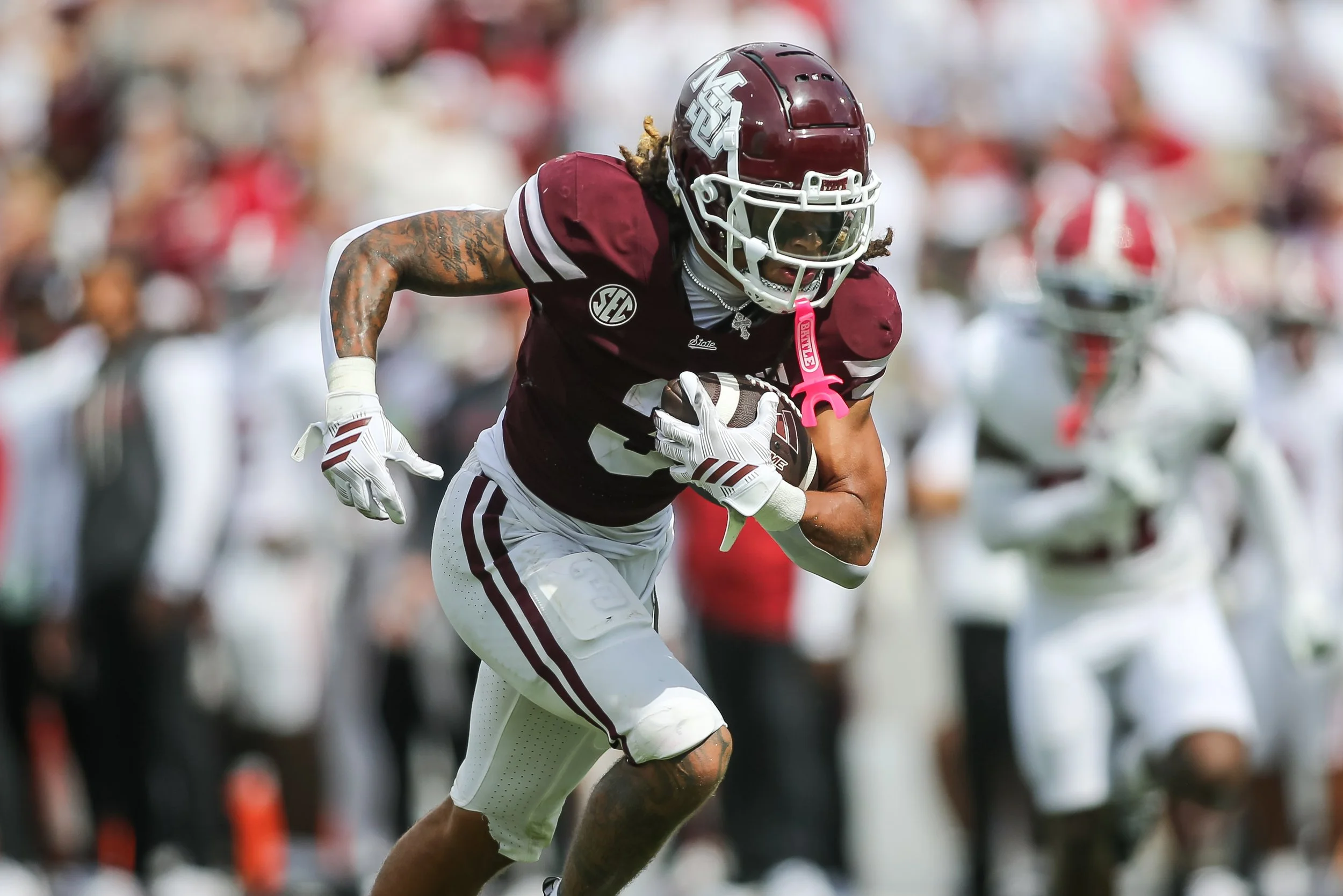
Mississippi State wide receiver Anthony Evans III (3) runs to the end zone after his catch against Alabama during the second half of an NCAA college football game in Starkville, Miss., Saturday, Oct. 3, 2026. (AP Photo/James Pugh)
The Bulldogs repeatedly find ways to involve him. He can provide an immediate completion or attack farther downfield, making him more than an underneath receiver.
Oklahoma must account for where he lines up without losing the other threats around him.
Sanfrisco Magee provides a scoring threat outside. Former Sooner Zion Ragins can stretch coverage, while Marquis Johnson gives Mississippi State another receiver capable of producing an explosive gain.
Taylor gives that group more opportunities downfield. With Puckett, finishing tackles becomes particularly important because the offense needs its receivers to create more after the catch.
The protection gives Oklahoma opportunities against either quarterback.
Mississippi State has surrendered 17 sacks through six games, with its offensive line charged with 10 of them. The group has allowed 45 pressures overall.
Left tackle Miles McVay has allowed 12 pressures and four sacks. Jakheem Shumpert-Perkins, who has primarily handled right tackle, has surrendered nine pressures and three sacks.
The interior hasn’t been impenetrable, either. Center Canon Boone has allowed seven pressures, while right guard LJ Prudhomme has surrendered six, including two sacks.
Oklahoma has opportunities to disrupt the pocket from multiple positions. But the difference between the team’s sack total and those charged to its blockers matters, too.
Taking away the first throw and making the quarterback hold the ball can be as important as winning immediately up front.
While Mississippi State’s offense depends partly on who’s available, its defense has established a clearer pattern.
The Bulldogs have been more dependable covering receivers outside than defending the space underneath. Their front can disrupt possessions, but it hasn’t consistently generated enough pressure to cover those openings.
That starts with Will Whitson.
Whitson leads Mississippi State with 14 pressures and two sacks. He gives the Bulldogs their most productive pass rusher off the edge, but he hasn’t repeatedly controlled games by himself.
The rest of the front hasn’t provided consistent pressure, either.
Mississippi State has generated 74 pressures and 12 sacks through six games. The disruption comes from several positions without a dominant individual forcing offenses to build their protection around him.
Amaree Williams and Dealyn Evans have each contributed eight pressures. Jaray Bledsoe has added seven from the interior.
Those players give Mississippi State ways to challenge more than an offensive tackle. Oklahoma must protect the middle of the pocket as well as its edges.
But the Bulldogs haven’t consistently turned those individual contributions into sustained pressure.
Mississippi State tries to create additional pressure from behind its defensive line.
Linebacker Tyler Lockhart has rushed 48 times, producing seven pressures and two sacks. Fatt Forrest has added two sacks, while safety Jardin Gilbert has contributed another.
Oklahoma must identify those additional rushers before worrying about the individual block.
Sending a linebacker can change a protection assignment and create an opening that the defensive line hasn’t consistently produced on its own. It can also leave space behind the rush.
Recognizing that space and getting the ball out will be part of John Mateer’s assignment.
The run defense presents a similar distinction.
The Bulldogs have capable defenders who can limit a carry before it reaches the second level.
Whitson has recorded seven stops against the run while missing only two tackles on running plays. Williams has missed only one, giving Mississippi State another dependable defender near the edge.
Evans has played better against the run in the last two games. Bledsoe has also shown he can win inside and disrupt a carry before the back finds an opening.
Oklahoma won’t establish its running game simply by choosing to run more often. Its offensive linemen must sustain blocks against defenders capable of winning those assignments.
The support behind that front has been less consistent.
Mississippi State has missed 38 tackles against the run through six games. When runners get through the front, Mississippi State hasn’t consistently finished tackles behind it.
Linebacker Jalen Smith has missed five tackles on running plays. Forrest has missed four despite playing considerably fewer run-defense snaps than Lockhart, who has missed three.
The Bulldogs can stop a run at the line of scrimmage. They’ve been less reliable when the runner forces another defender to finish it.
For an Oklahoma offense struggling to generate dependable rushing production, those additional yards matter. Getting a back through the first opening must become a manageable next down rather than another possession dependent on a difficult throw.
There are clearer opportunities in coverage.
Cornerbacks Jett Jefferson and Kelley Jones have generally made outside completions difficult.
Jefferson has allowed 17 catches on 34 targets for 178 yards. Jones has surrendered nine receptions on 20 targets for 140.
Neither has been unbeatable. But opponents haven’t consistently moved the ball by repeatedly challenging them outside.
The linebackers have allowed a much different result.
Lockhart has surrendered 29 catches on 30 targets for 271 yards. That vulnerability has persisted across opponents rather than appearing in one poor performance.
Offenses have repeatedly found the receiver in his coverage and completed the throw.
Forrest has allowed 10 catches on 12 targets for 117 yards. Smith has surrendered 11 receptions on 15 targets for another 115.
Those numbers reveal where Oklahoma can find movement without repeatedly asking its outside receivers to beat the cornerbacks.
Rocky Beers gives the Sooners a tight end capable of working through that space. The running backs provide another way to make Mississippi State’s linebackers defend a receiver rather than attack the pocket.
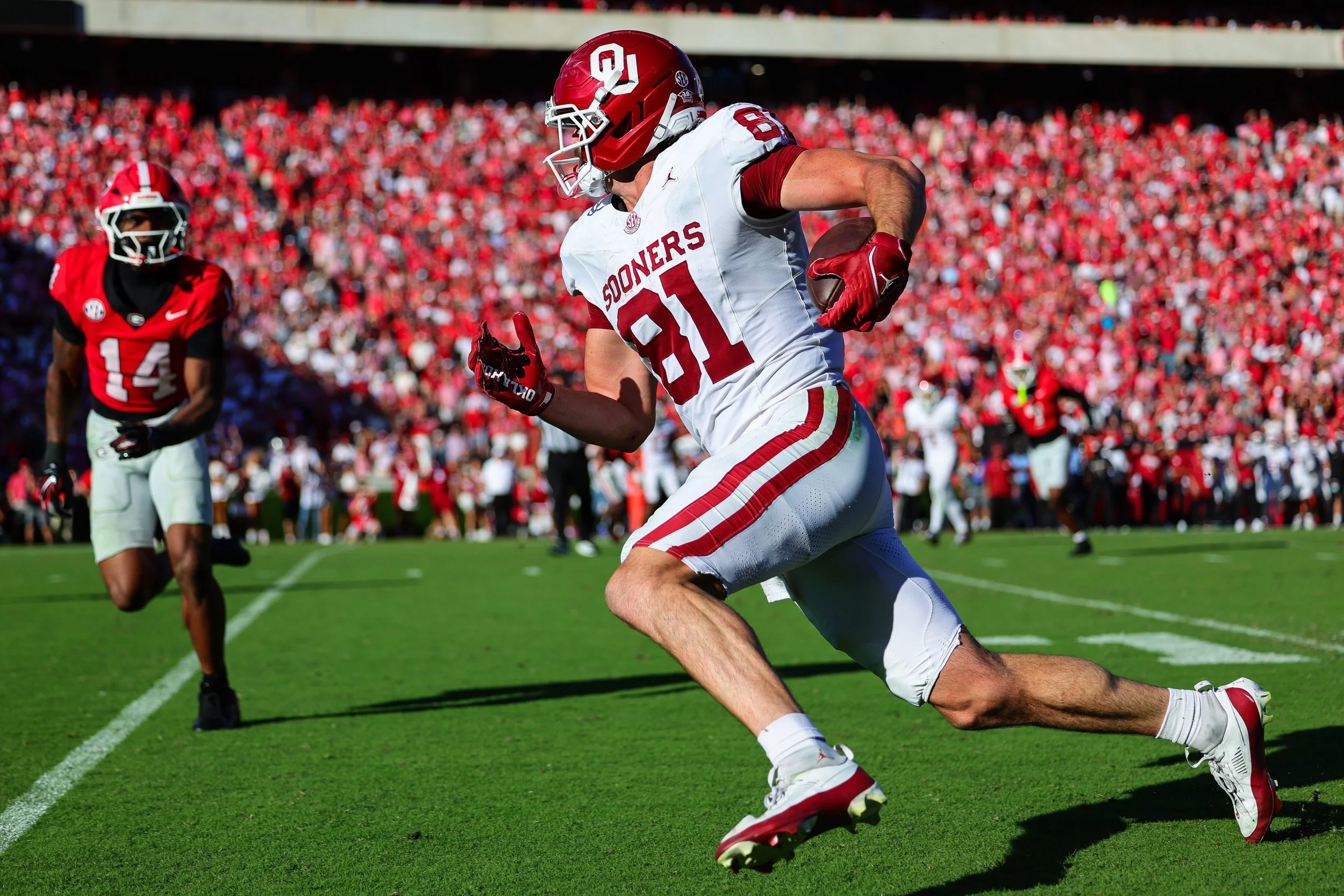
Oklahoma tight end Rocky Beers (81) runs the ball before scoring a touchdown during the second half of an NCAA college football game against Georgia, Saturday, Sept. 26, 2026, in Athens, Ga. (AP Photo/Colin Hubbard)
Getting Isaiah Sategna involved inside would also test a different part of the coverage than leaving every assignment outside.
The opportunity isn’t simply to complete a short pass. It’s to make the underneath defenders handle repeated coverage assignments, finish tackles and defend the next snap.
Mississippi State has already shown how those completions can become enough to sustain possessions.
Against LSU, Jefferson and Jones combined to allow only four catches for 33 yards. The defense still surrendered 29 completions for 276 yards, with 188 coming after the catch.
The cornerbacks held up. The coverage around them didn’t prevent the passing game from moving.
Taken together, Mississippi State has shown an offense capable of threatening several parts of the field when Taylor and Bothwell are available, alongside a defense stronger outside than underneath.
Their returns would expand what Oklahoma must defend. Their absences wouldn’t remove Evans, the quarterback running threat or the need to finish tackles.
The Sooners must limit the help around the quarterback, make him operate under pressure and take the available throws against Mississippi State’s linebackers.
The opportunities are there.
Oklahoma must sustain enough possessions to make them matter.