
Steve Curtis- Oklahoma’s Offense Must Stay Patient to Break Michigan’s Defense
Steve Curtis | September 11th, 2026
Oklahoma’s offense spent most of its season opener playing comfortably.
The Sooners scored early, protected John Mateer and never gave UTEP an opportunity to make the game competitive.
That comfort will disappear Saturday in Ann Arbor.
Not because Oklahoma enters as an underdog. The Sooners are favored by 5.5 points and expected to leave Michigan Stadium with more than a narrow victory. The question is whether they can remain in control when Michigan’s defense, quarterback and home crowd create problems UTEP could not.
The first test is how Mateer handles Michigan’s pressure.
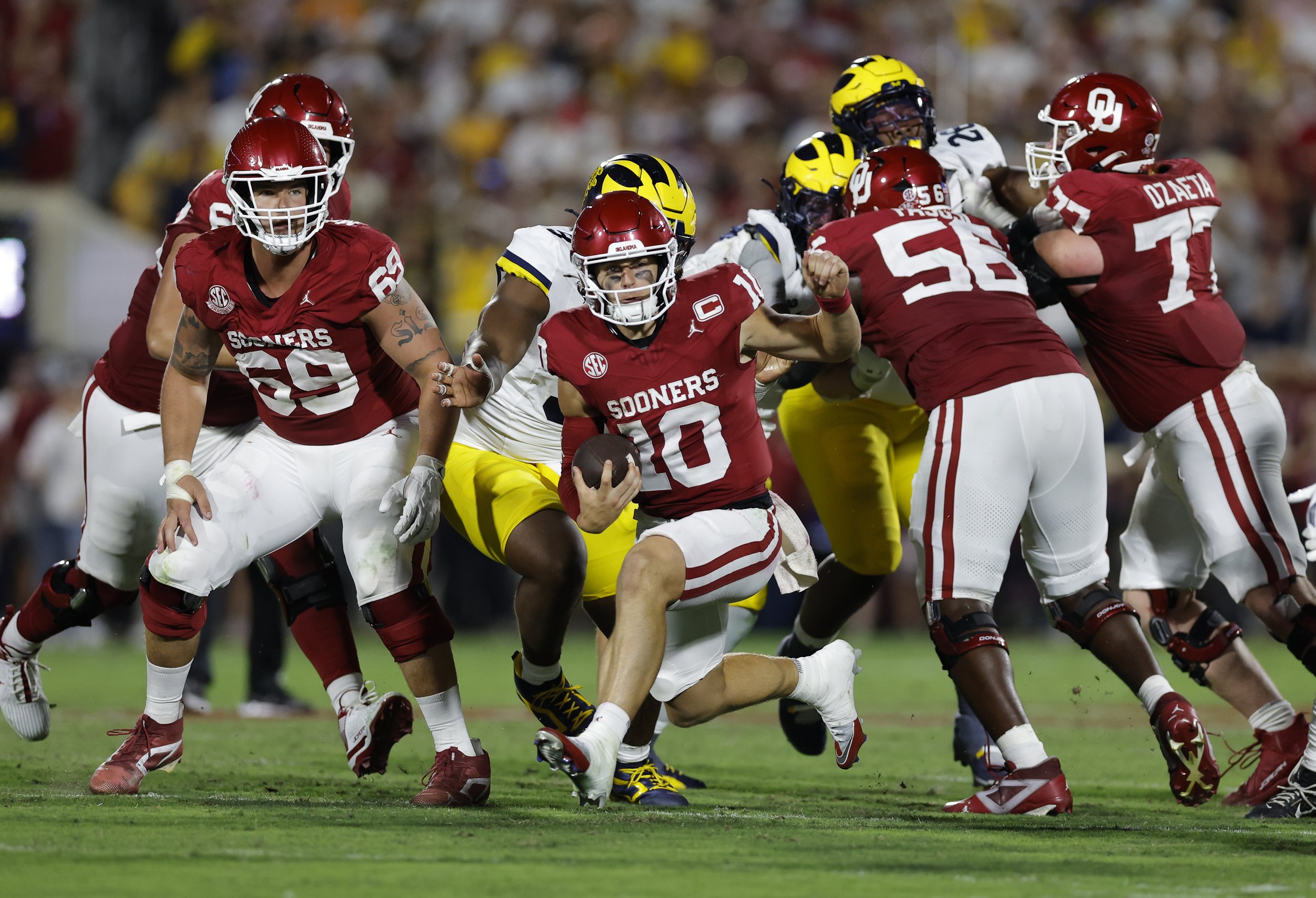
Against UTEP, Mateer completed 11 of 17 passes for 225 yards and three touchdowns. The numbers mattered, but the way he produced them was more important.
Mateer pushed the ball downfield, stood comfortably inside the pocket and finished without a turnover. He looked like a far more refined version of the player Oklahoma saw before his thumb injury than the one who struggled after surgery.
Michigan will try to make him uncomfortable again.
On the edge, Dom Nichols recorded four pressures and two sacks against Western Michigan, consistently winning his matchup and finishing once he reached the backfield. John Henry Daley added two pressures from the opposite side, giving Michigan another threat Oklahoma cannot ignore.
The Wolverines do not need to overwhelm the offensive line on every snap.
One or two early hits could be enough to speed up Mateer and force him to decide whether to take the available completion or hold the ball in search of something larger.
That decision has followed him throughout his Oklahoma career.
Mateer’s ability to extend plays is one of his greatest strengths. It has also led him to pass up easy yards and invite pressure that the offensive line initially handled.
Saturday will require a balance.
Oklahoma needs Mateer to remain aggressive without allowing Michigan’s defensive ends to turn the game into a series of sacks, hurried throws and third-and-long situations.
That responsibility does not belong to Mateer alone.
Oklahoma’s offensive line did not allow a sack while he played against UTEP despite missing Jake Maikkula and Ryan Fodje.
Both are widely expected to return Saturday, but the Sooners will still be forced to change the starting five.
Michael Fasusi is expected to miss the game with a shoulder injury, requiring Fodje to move to left tackle. Maikkula will return at center, while true freshman Noah Best is expected to slide to right guard beside E’Marion Harris.
The return of two starters should help, but replacing Fasusi creates a new problem at one of the most critical positions along the line.
Fodje started at right tackle late last season before moving back to guard, the position he was initially recruited to play, during the offseason. However, Fasusi’s shoulder injury gave Fodje extensive work at left tackle throughout fall camp.
That experience should make the move less abrupt.
Still, his first start of 2026 would come against the most productive player on Michigan’s defense in Nichols.
That matchup will test Fodje from the opening possession, while the Wolverines’ zone looks can create pressure elsewhere without leaving the secondary completely exposed.
Communication will be just as important as winning individual blocks.
Oklahoma cannot afford protection mistakes caused by the crowd while breaking in another offensive line combination. A missed assignment in Norman against UTEP could be corrected on the next play. In Ann Arbor, it could give Michigan the momentum it needs to take control.
The best way to relieve that pressure is by keeping the Wolverines from knowing when Oklahoma has to throw.
That puts the run game under a much brighter spotlight.
Lloyd Avant, Xavier Robinson and Jonathan Hatton Jr. found room against UTEP, helping Oklahoma’s running backs finish with 162 yards on 33 carries.
The Sooners did not dominate every snap. They did, however, avoid the repeated tackles for loss that disrupted the run game last season, allowing the backs to stay on schedule and finish runs moving forward.
Michigan will challenge that progress inside.
Defensive tackles Enow Etta and Trey Pierce were more effective against the run than as pass rushers in the opener. Behind them, Troy Bowles and Nathaniel Staehling combined for 19 tackles and rarely allowed Western Michigan’s backs to turn modest gains into explosive plays.
The Sooners don't need 200 rushing yards to win.
But they can't abandon the run after a few short gains and allow Michigan's defensive ends to attack Mateer without hesitation.
Three or four yards may be enough early. If Avant and Robinson keep Oklahoma ahead of the chains, Ben Arbuckle can use tempo and play action to prevent Michigan from settling into the game it wants to play.
Hayden Hansen and Rocky Beers will play a significant role in creating that balance.
Their presence allows Oklahoma to add bodies at the line of scrimmage without becoming predictable. The Sooners can run behind them, keep them in protection or release them against linebackers and safeties.
Beers’ 40-yard touchdown against UTEP showed the danger of treating Oklahoma’s tight ends as nothing more than additional blockers. He caught the ball 19 yards downfield, added 21 yards after the catch and hurdled a defender for the score.
If Oklahoma can run efficiently from 12 and 13 personnel, Michigan will have to commit more defenders near the line of scrimmage. That would give Oklahoma's receivers, Isaiah Sategna,
Trell Harris, Elijah Thomas and Parker Livingstone more opportunities to work downfield against man coverage.
Sategna remains Oklahoma’s most dangerous receiver, but UTEP could not devote all its attention to him. Harris caught a 48-yard touchdown, Thomas made one of the best catches of the night along the sideline and Livingstone provides another explosive target..
That distribution matters against a Michigan secondary that will be determined to keep the ball in front of it.
Western Michigan completed 15 of 19 passes but gained only 89 yards through the air. The Wolverines were willing to concede short throws because none became explosive plays.
Oklahoma will have to earn the right to attack deeper.
If the Sooners remain efficient on the ground and force Michigan to account for the tight ends, Mateer should have opportunities to isolate his receivers outside. If Oklahoma becomes one-dimensional, the Wolverines can keep everything in front of them while allowing Nichols and Daley more time to reach the pocket.
Michigan’s plan will be clear: make Oklahoma impatient.
The Wolverines can create pressure off the edge, limit explosive plays and force the Sooners to repeatedly earn their way down the field.
Oklahoma has enough answers to prevent that.
If the offensive line protects Mateer, the running backs keep Oklahoma ahead of the chains and the tight ends force Michigan to defend every part of the formation, opportunities will eventually open downfield.
The Sooners do not need to force those opportunities before they arrive.
UTEP showed that Oklahoma’s offense is healthier, deeper and more balanced than it was a year ago.
Saturday will show whether it can maintain that balance when the game is no longer comfortable.