
Steve Curtis | November 4th, 2026
Oklahoma will travel to Gainesville on Saturday with Jason Witten calling plays for the first time after a 42-25 loss to South Carolina.
Unlike the Sooners, Florida has already changed quarterbacks in search of more answers on offense.
The Gators have gotten productive stretches from both Aaron Philo and Tramell Jones Jr. But their first eight games have shown how much easier it is to move the ball when neither quarterback has to do it alone.
That starts with running back Jadan Baugh.
Baugh has handled most of the work out of the backfield. He can keep a carry productive when the blocking breaks down, giving Florida a way to stay on schedule without needing a clean opening on every handoff.
Against Ole Miss, 103 of his 142 rushing yards came after contact, according to Pro Football Focus (PFF). His longest run went for 23 yards. Florida could give him the ball 29 times because he kept getting something out of the carries in between.
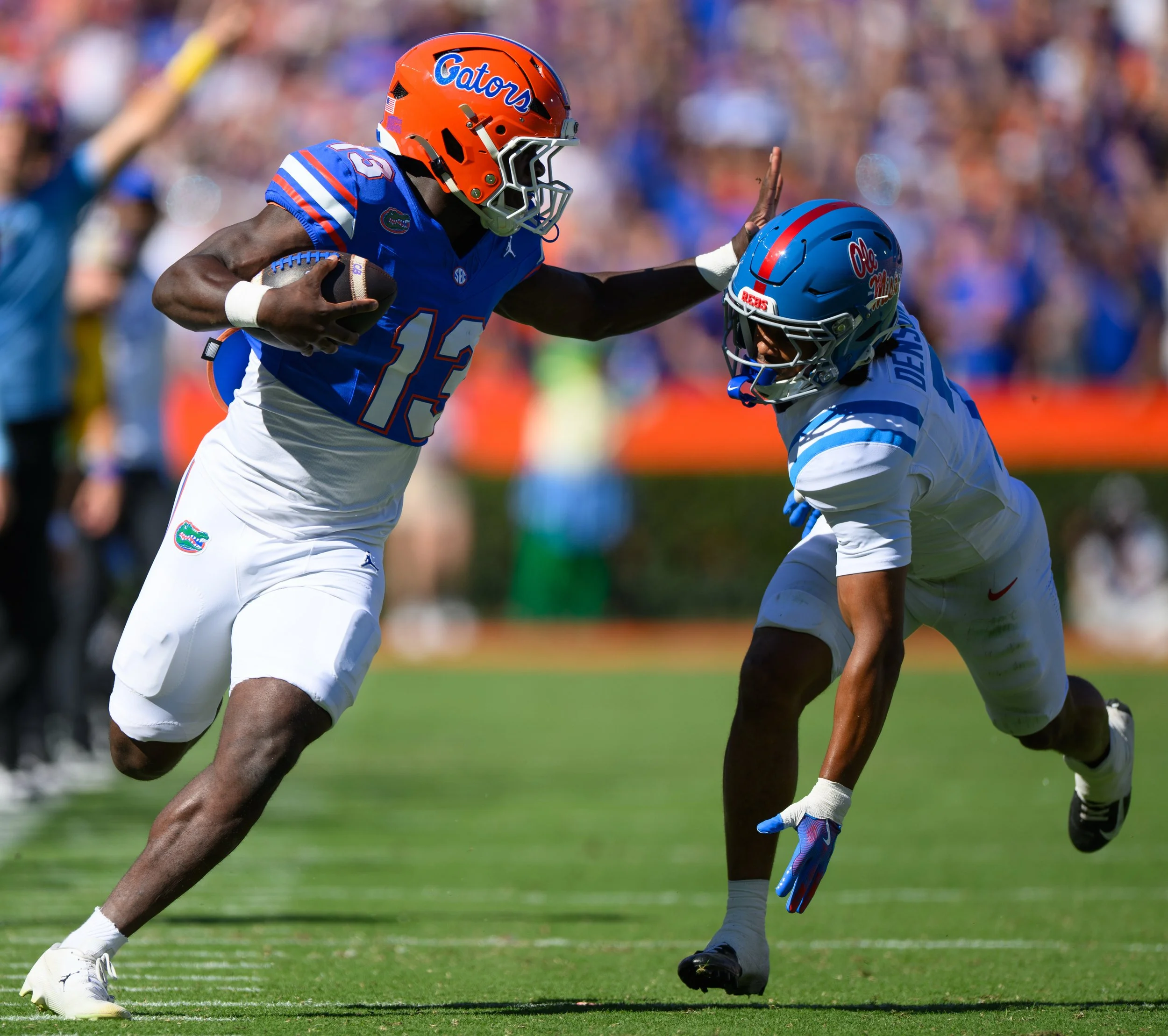
Florida running back Jadan Baugh (13) stiff-arms Mississippi safety Sharif Denson (7) during the first half of an NCAA college football game, Saturday, Sept. 26, 2026, in Gainesville, Fla. (AP Photo/Noah Lantor)
Duke Clark gives Florida another back who can do the same thing. He gained 126 yards on 12 carries against Ole Miss, with 97 coming after contact.
The Gators can change backs without giving a defense much relief. But both backs need enough room for a broken tackle to matter.
Missouri held Baugh to 13 yards. Georgia held him to 38. PFF credited him with more yards after contact than total rushing yards in both games.
Baugh was still gaining ground after defenders reached him. Too often, he was using those yards to get back to the line of scrimmage.
That matters for Oklahoma’s defensive front. Meeting Baugh in the backfield gives the linebackers a chance to finish a short gain. Let him get through the line first, and the same tackle can leave Florida with a second down it can run on again.
Once the handoff stops keeping Florida ahead of the chains, the protection has to hold up for longer.
Right guard TJ Shanahan Jr. has given the Gators some stability. PFF charged him with no pressures against Missouri or Georgia. But against Georgia, Bryce Lovett surrendered two sacks at right tackle, while Harrison Moore allowed a sack after lining up at left guard.
Moore had gone without allowing a pressure at center against South Carolina. Florida has gotten good protection from individual linemen, but a clean pocket depends on more than its best blocker winning his assignment.
Philo has shown how much that changes the passing game.
He threw for 221 yards from clean pockets against South Carolina. Under pressure, he managed 6 passing yards and threw an interception.
But South Carolina still had to defend him after the first throw disappeared. Philo rushed for 56 yards, nearly matching Baugh’s production. Oklahoma can take away the pass and still give Florida a manageable next down if the rush leaves him somewhere to go.
Jones presents a similar problem.
Texas held him to two completions under pressure in his first start. He still threw two touchdown passes and added 50 rushing yards. The Longhorns could make him less effective as a passer and still have to finish the play once he left the pocket.
Florida turned to Jones against Georgia after pulling Philo, who started and threw his second interception early in the second quarter.
The freshman signal caller gave the Gators an answer underneath. Bailey Stockton caught all eight of his targets for 76 yards, providing a place to go inside when the running game couldn’t keep the offense moving.
That helped Florida move the chains. Finishing through the air remained a problem. Jones completed more than 70% of his passes, but one trip inside the Georgia 20 ended with an interception in the end zone. Florida got a touchdown from Jones on the ground and went without one through the air.
Stockton gives either quarterback a dependable short throw. Vernell Brown III can get more out of an opportunity from the slot.
Brown caught five passes for 86 yards against Auburn. Dallas Wilson added 74 yards and a touchdown on four catches, giving Florida a threat outside without needing the same volume of throws Stockton saw against Georgia.
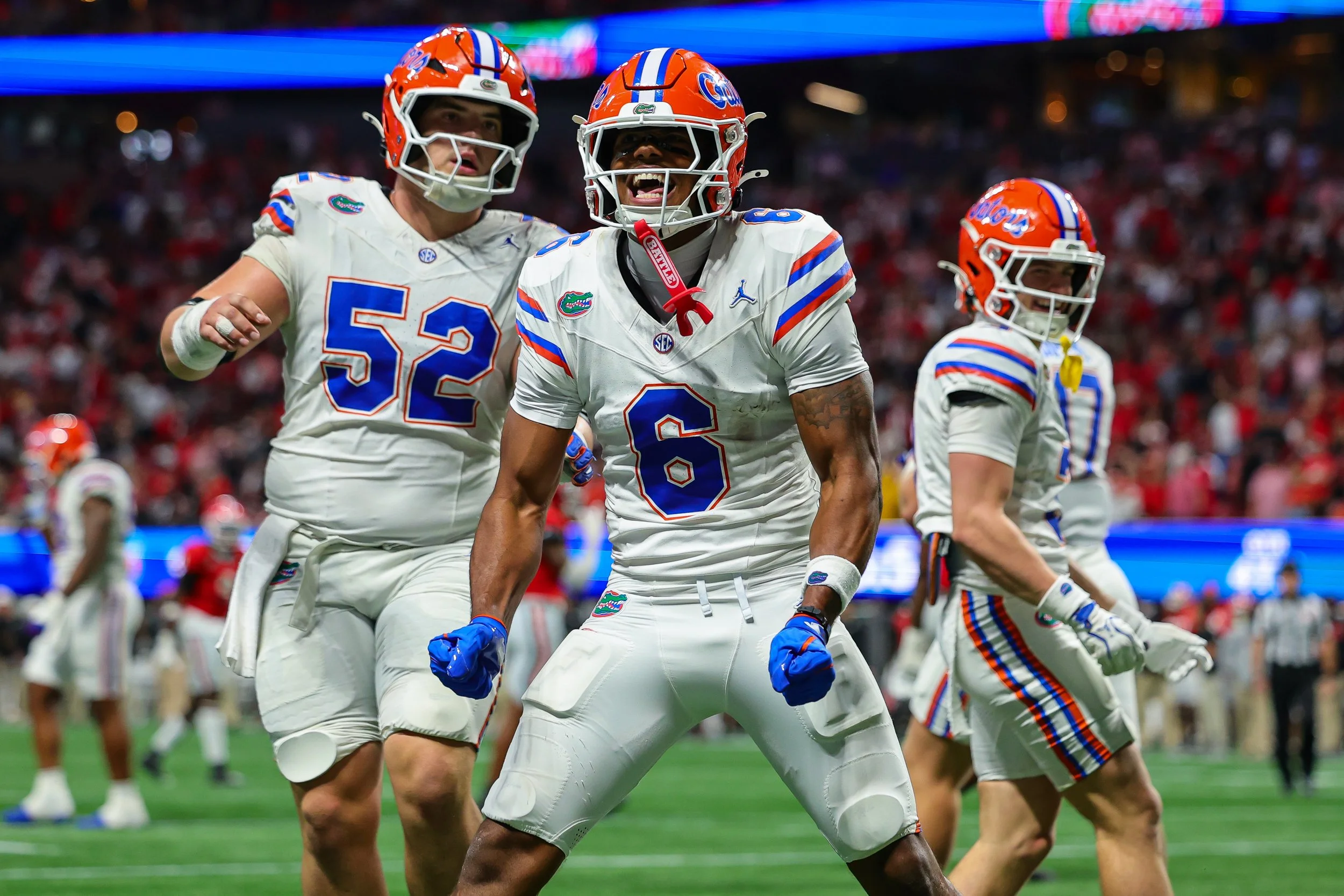
Florida wide receiver Dallas Wilson (6) reacts with offensive guard Harrison Moore (52) after converting a two-point conversion in the second half of an NCAA college football game against Georgia, Saturday, Oct. 31, 2026, in Atlanta. (AP Photo/Colin Hubbard)
Wilson also scored against Missouri when Baugh could get little going, meaning Florida still had a way to get downfield when the handoffs were taken away.
Oklahoma has to respect that throw without making the short ones easier. If Brown or Stockton can move the chains underneath, Florida gets another chance to give Baugh the ball before it has to ask either quarterback to convert a long third down.
On the other side of the ball, Florida’s defense has been at its most disruptive when the other team gets stuck in those situations.
Emmanuel Oyebadejo and Jayden Woods each recorded three sacks against Auburn, according to PFF. LJ McCray had two against Texas, while linebackers Jaden Robinson and Ty Jackson each added one.
Florida can make a tackle account for Woods and still get pressure from a linebacker inside. That gives the Gators more than one way to reach the quarterback when an offense needs time for a route to develop.
The pressure hasn’t been as consistent as those games suggest.
Woods had a sack against Ole Miss, but it was his only pressure. The Gators got a negative play without making the quarterback hurry his throws throughout the game.
That leaves more for the coverage to handle, and Florida has held up better in some matchups than others.
Cormani McClain intercepted a pass against Auburn and allowed one catch for 3 yards against Texas. Ben Hanks III held the catches in his coverage to 20 yards against South Carolina.
LaNorris Sellers still threw four touchdown passes. Florida can get good work from a corner and give up enough elsewhere for an offense to keep moving.
Ole Miss found room against Myles Graham, whom PFF charged with 47 yards on two catches. One went for 33 yards. There are throws available inside even when a quarterback has a difficult matchup outside.
That gives Oklahoma somewhere to look with Isaiah Sategna and its tight ends. The Sooners can make Florida’s linebackers cover those throws or give John Mateer space to use when one of them rushes.
But Oklahoma has to get to those downs with the run still available. If Florida knows Mateer needs to hold the ball for a route beyond the sticks, Woods and the rest of the front have already shown what they can do with the extra time.
Taken together, Florida’s first eight games have revealed a team whose best players can make difficult downs easier. Baugh can turn a poor block into a productive carry. Either quarterback can run when the first throw disappears. The defensive front can end a possession before the secondary has to defend another pass.
Oklahoma has to make Florida sustain drives when those plays aren’t there. Get to Baugh before he gets downhill, keep the quarterback in the pocket and make the Gators finish drives through the air.
Then give Mateer the kind of downs Florida has spent eight games trying to create for its own quarterbacks.