
Steve Curtis | November 11th, 2026
Ole Miss will arrive in Norman looking to recover from a game in which little worked on either side of the ball.
Georgia beat the Rebels 42-7 on Saturday, dropping Pete Golding’s team to 6-3 with its second loss in three games. Ole Miss has beaten LSU, Missouri and Auburn, but its losses to Florida, Texas and Georgia have exposed different ways its offense and defense can break down.
The Rebels have enough receiving options to keep moving when their running backs struggle. Their defensive front can disrupt a possession from the edge, the interior or a linebacker coming behind it.
Neither has been dependable enough to keep Ole Miss from needing answers elsewhere.
That starts with the help around quarterback Trinidad Chambliss.
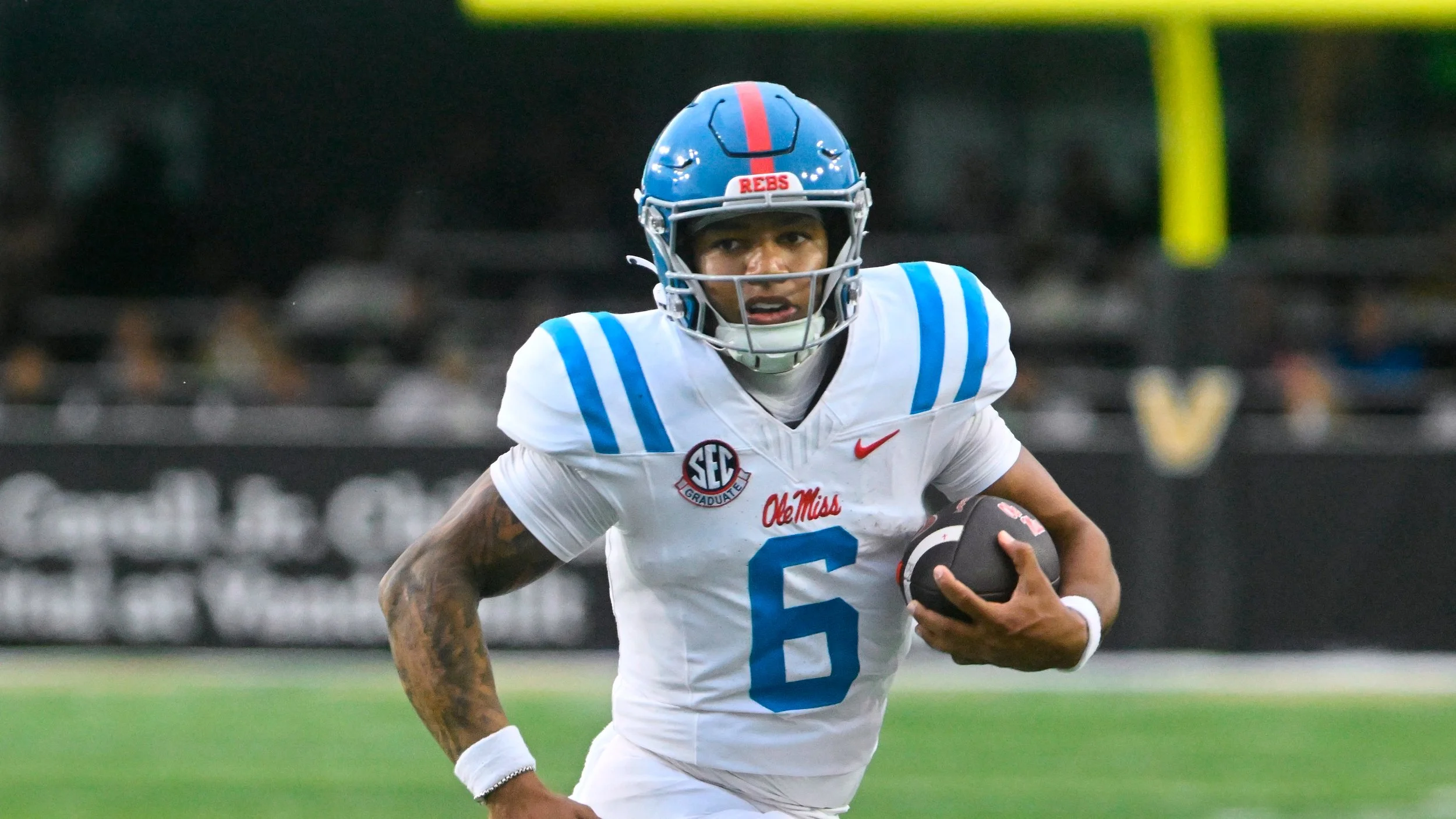
Mississippi quarterback Trinidad Chambliss (6) plays Vanderbilt during an NCAA college football game in Nashville, Tenn., Saturday, Oct. 10, 2026. (AP Photo/John Amis)
Kewan Lacy has shown what the running game can provide when a back gets enough room to work.
Against Missouri, Lacy rushed for 122 yards on 16 carries. According to Pro Football Focus (PFF), 82 came after contact. His longest run went for 23 yards, meaning the production extended beyond one opening.
Makhi Frazier added 101 yards in the same game.
Ole Miss could change backs and continue gaining ground without asking Chambliss to carry every possession.
But the Rebels haven’t repeatedly created that kind of movement against SEC opponents.
Lacy gained 29 yards against LSU, with 22 coming on one carry. Texas held him to 36 yards on 16 attempts, with no run longer than 6 yards.
Meeting him before he gets through the line changes how much a broken tackle can accomplish. Against LSU, PFF credited Lacy with more yards after contact than total rushing yards.
He was still gaining ground after defenders reached him. Too often, that meant recovering yards already lost.
Lacy’s availability has complicated that effort.
He has dealt with injuries off and on, keeping Ole Miss from consistently having its most productive back available. He did not record a carry against Auburn or Georgia, leaving Shekai Mills-Knight and Makhi Frazier to handle most of the work.
Mills-Knight gained 71 yards against Auburn before rushing for 52 against Georgia. Frazier managed only 8 yards on four carries against the Bulldogs.
Those backs give Ole Miss alternatives when Lacy can’t go. His availability still changes how much help Chambliss can expect from the running game.
Nor does stopping those backs automatically fix the passing game for an opponent.
Lacy and JT Lindsey combined for 49 yards on 14 carries against LSU. Chambliss still threw for 364 yards and two touchdowns in a 32-24 win.
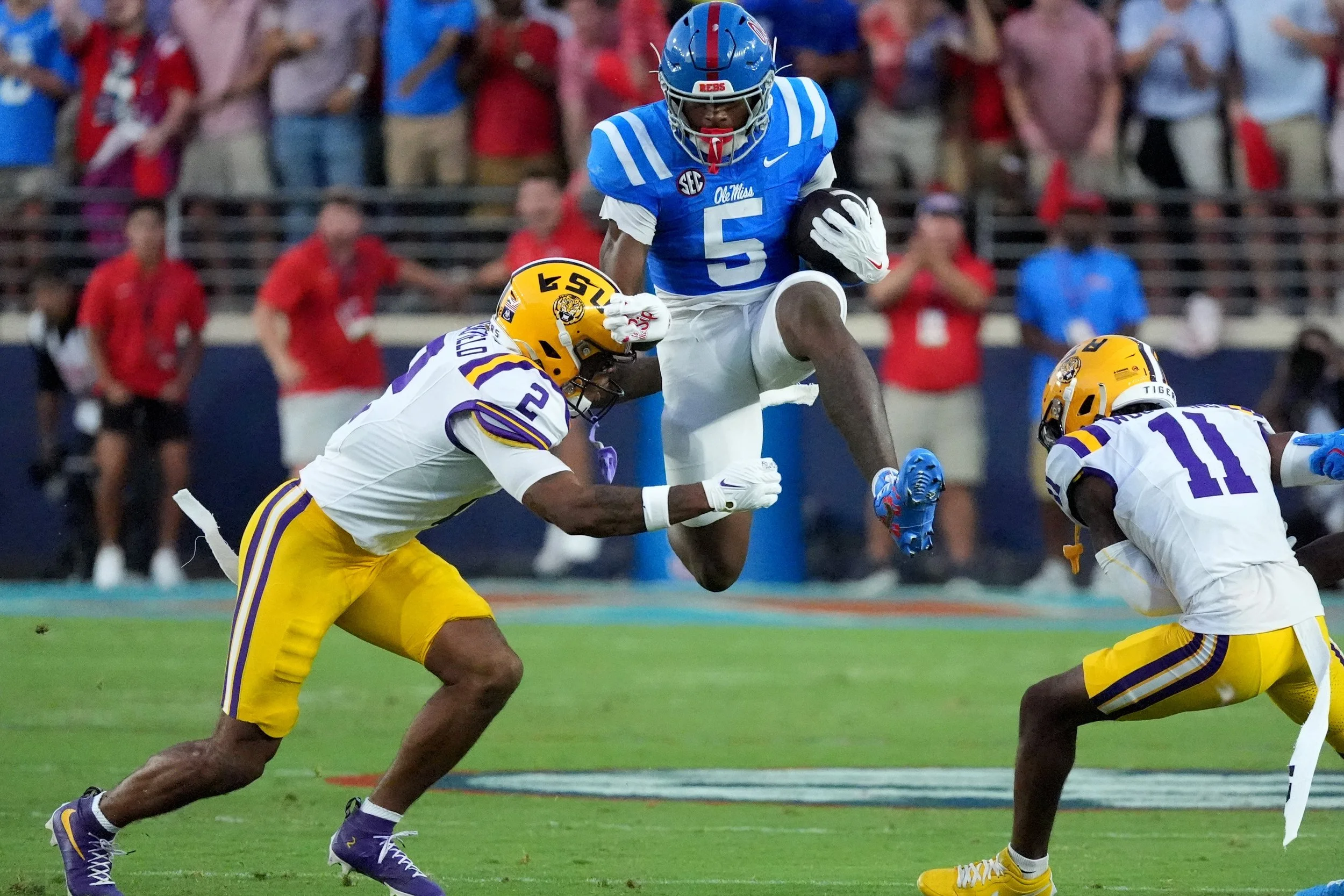
Mississippi running back Kewan Lacy (5) leaps between LSU safety Ty Benefield (2) and cornerback PJ Woodland (11) during the first half of an NCAA college football game in Oxford, Miss., Saturday, Sept. 19, 2026. The play was called back. (AP Photo/Rogelio V. Solis)
The Rebels could put more of the offense in his hands without needing the handoff to improve first.
That matters because Chambliss hasn’t depended on play action for every productive throw. Against LSU, 270 of his passing yards and both touchdowns came without it.
Oklahoma must limit the backs without assuming the passing opportunities will disappear with them.
Pressure provides a clearer way to make those throws difficult.
Georgia pressured Chambliss on 17 of his 41 dropbacks. He completed four of 12 passes for 38 yards under pressure, threw an interception and took four sacks.
The Bulldogs made him operate without a dependable running game or enough time to find another answer.
But Texas showed that Ole Miss’ mistakes don’t always require a defender reaching the quarterback.
Chambliss threw all three of his interceptions from clean pockets against the Longhorns. Texas went without a sack and still held him below 50% passing.
Oklahoma can disrupt a possession by taking away the available throw, even when the initial block holds.
It still has to finish the play.
Chambliss rushed for 63 yards and a touchdown against Auburn. Only one of his carries was a scramble, showing that Ole Miss can involve him in the running game before a passing play breaks down.
Leaving him unaccounted for while following the back gives the Rebels another way to create a manageable next down.
His receivers present different problems.
Deuce Alexander gives Ole Miss a threat outside who can produce more than the throw alone provides.
Alexander caught five passes for 159 yards and two touchdowns against Louisville, then caught all seven of his targets for 134 yards against Florida. He can change a possession without needing repeated completions.
But he went without a catch on one target against Georgia.
Horatio Fields provided the more dependable option that night, catching eight passes for 96 yards. Fields also caught both of Chambliss’ touchdown passes against Texas.
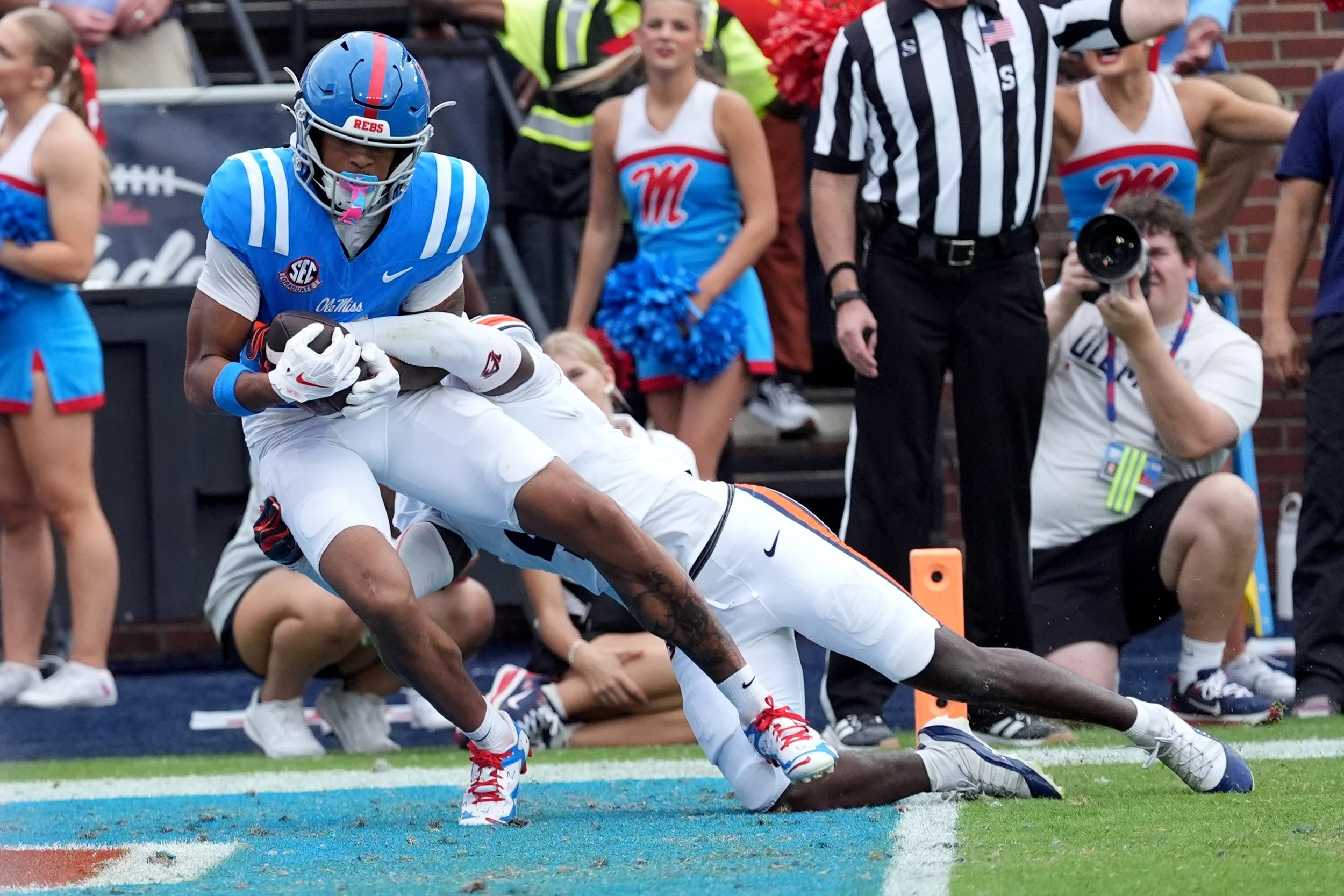
Mississippi wide receiver Horatio Fields (11) holds onto a touchdown pass as he is tackled in the end zone by an Auburn defensive player during the second half of an NCAA college football game in Oxford, Miss., Saturday, Oct. 31, 2026. (AP Photo/Rogelio V. Solis)
Taking Alexander away doesn’t remove the receiver capable of finishing a scoring opportunity.
Traylon Ray gives Chambliss another option inside. He worked primarily from the slot against LSU, catching seven passes for 115 yards and a touchdown.
Caleb Odom adds a tight end who can threaten the same space without being limited to short completions. He produced 88 yards against LSU and added 66 yards and a touchdown on three catches against Louisville.
Caleb Cunningham has contributed outside, while Luke Hasz gives Ole Miss another tight end to involve underneath.
Oklahoma can’t build its coverage around one receiver and assume the others will remain quiet.
The protection gives its defensive front opportunities to help.
Center Brycen Sanders has provided clean work in several games, going without a pressure allowed against Auburn, Missouri and Texas. Against Georgia, however, left tackle Terez Davis surrendered five pressures, while Tommy Kinsler IV allowed three, including a sack.
The help beside the offensive line broke down, too. Frazier allowed four pressures on six pass-blocking snaps against Georgia.
Keeping a back in protection doesn’t help if he can’t handle the defender coming through. Oklahoma’s defensive front can test those assignments without needing to beat Sanders in the middle.
While Ole Miss’ offense has struggled when its help breaks down, its defense has shown how much disruption can change what happens behind the front.
Will Echoles provides that threat inside.
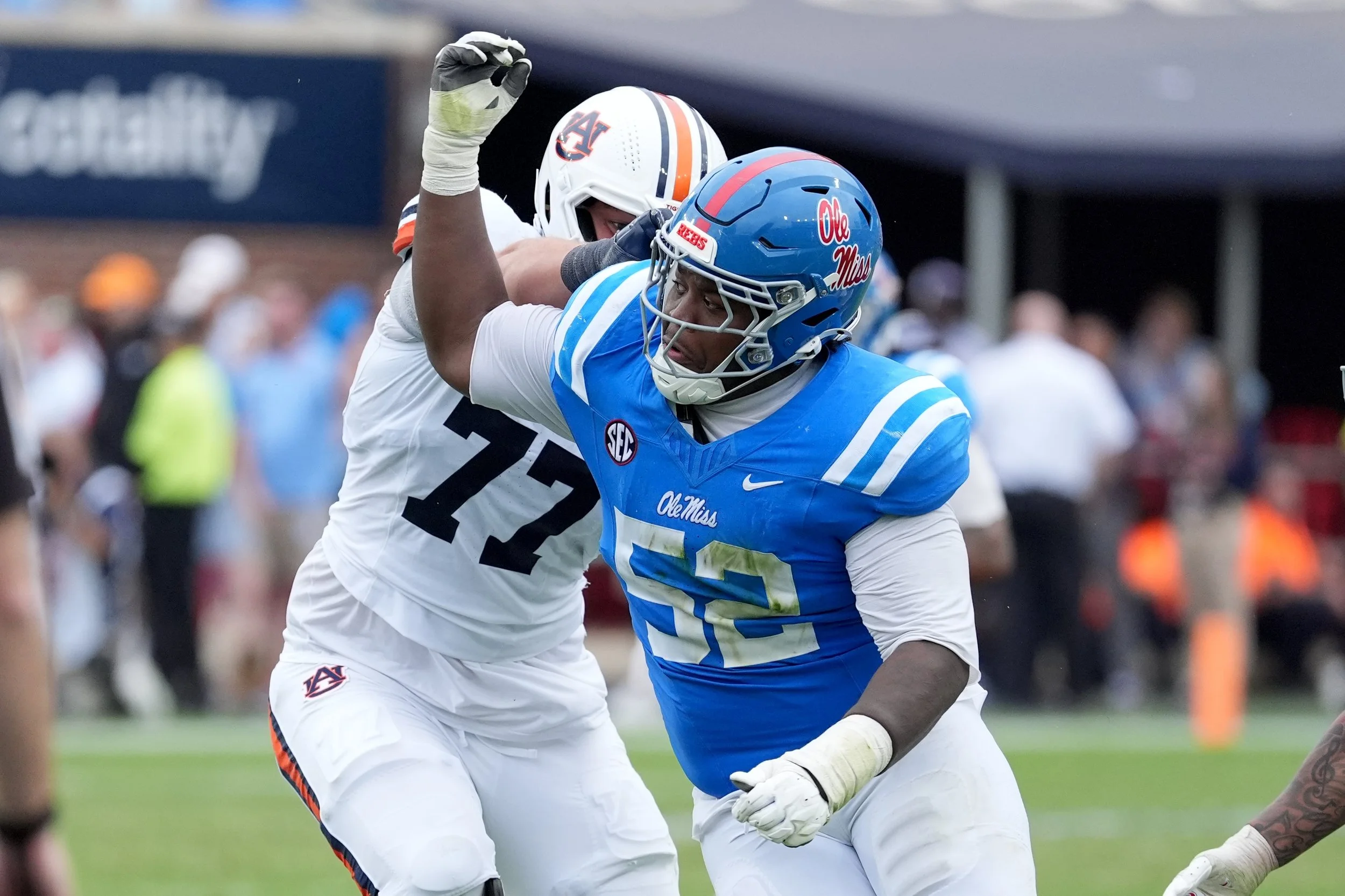
Mississippi defensive tackle Will Echoles (52) fights off an attempted block by Auburn offensive lineman Wilson Zierer (77) during the second half of an NCAA college football game in Oxford, Miss., Saturday, Oct. 31, 2026. (AP Photo/Rogelio V. Solis)
Echoles generated seven pressures and a sack against LSU. Blake Purchase and Kam Franklin added pressure off the edge, while linebackers Keaton Thomas and Luke Ferrelli each contributed a sack.
The Rebels finished with five sacks from five defenders.
Helping an offensive tackle won’t solve Oklahoma’s protection if Echoles wins inside or a linebacker comes through unblocked. John Mateer must recognize where the additional rusher is coming from and have somewhere to go with the ball.
But Ole Miss hasn’t consistently forced quarterbacks to hurry.
The Rebels produced six pressures without a sack against Florida. Against Georgia, PFF credited the defense with only three pressures.
Georgia also kept Ole Miss from getting enough obvious passing opportunities to make the rush matter.
Nate Frazier opened his afternoon with a 46-yard run. The Bulldogs continued finding productive carries through the middle and on the perimeter, reaching halftime with a 28-0 lead.
Oklahoma doesn’t need to match Georgia’s explosive plays to benefit from that approach. Keeping the run available would make Ole Miss defend another handoff before sending its linebackers after Mateer.
Those carries still have to get past capable defenders.
Thomas recorded six stops against the run without a missed tackle against Auburn. Franklin has also provided dependable work near the line, including five run stops against Texas.
The Rebels can end a carry early. Their worst games have shown what happens when the blocks hold and the defenders behind them have to finish it.
There are opportunities through the air as well.
Jaylon Braxton allowed only one catch against Auburn, for a loss of a yard. Antonio Kite went without allowing a completion against LSU. Against Texas, Jalyn Crawford intercepted two passes from Arch Manning.
The outside coverage can punish a careless throw without holding up in every matchup.
Missouri completed six of seven targets against Crawford for 70 yards. Georgia gained 64 yards on two catches against Braxton.
Oklahoma has opportunities outside, but it also has reason to involve Isaiah Sategna, its tight ends and its backs inside.
Florida gained 48 yards on three catches against Ferrelli, with 46 coming after the catch. Against Texas, Tah’j Butler allowed a 43-yard reception that produced 44 yards after the catch.
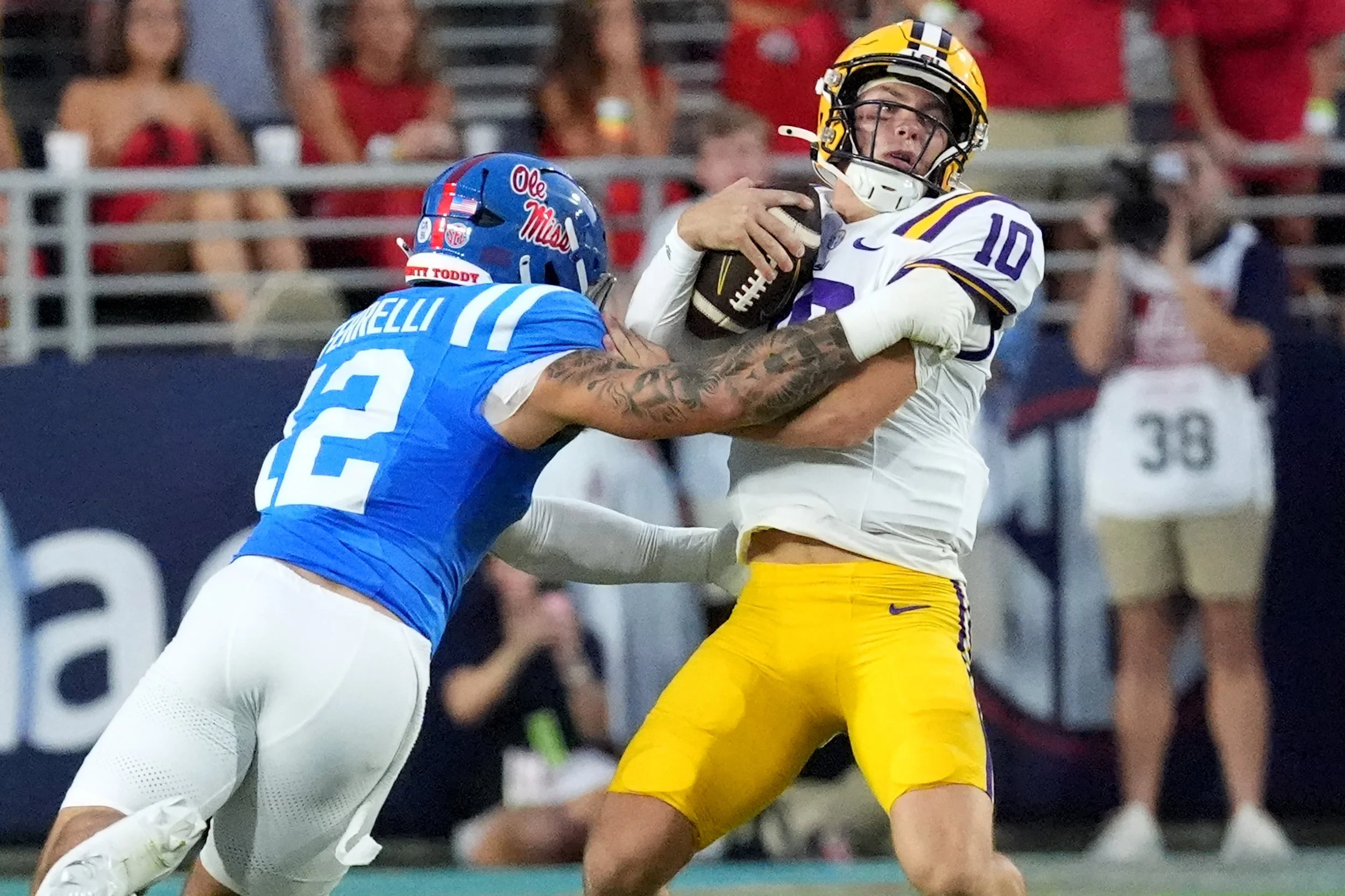
LSU quarterback Sam Leavitt (10) attempts to fight off a arm tackle by Mississippi linebacker Luke Ferrelli (12) during the first half of an NCAA college football game in Oxford, Miss., Saturday, Sept. 19, 2026. (AP Photo/Rogelio V. Solis)
A short throw can become enough if Oklahoma gives the receiver room and makes the next defender finish the tackle.
Taken together, Ole Miss’ first nine games have revealed a team capable of winning without a dependable running game, but less capable of surviving when the protection and defense fail alongside it.
Chambliss has receivers who can keep possessions moving. Echoles and the defenders around him can stop one before the coverage has to hold up again.
Oklahoma must take away the help around Chambliss without forgetting what he can create himself. Then keep the run available, identify the extra rushers and take the throws Ole Miss leaves open.
The Rebels have already shown they can recover from a loss.
Oklahoma must make the problems Georgia exposed last another week.