
Steve Curtis - Behind Enemy Lines: Texas
Steve Curtis | October 7th, 2026
For Oklahoma and Texas, no game means more.
The Sooners are set to face Steve Sarkisian’s No. 1-ranked Longhorns on Saturday in the 122nd edition of the Red River Shootout at the Cotton Bowl, where a year’s worth of bragging rights comes down to one afternoon.
This year, Texas arrives unbeaten, having already survived two tough tests with a 24-23 win over Ohio State and a 20-17 victory at Tennessee. The Longhorns paired those results with comfortable wins over Texas State and UTSA.
Texas hasn’t needed to overwhelm every opponent to reach 4-0. The Longhorns’ first four games have revealed a team with enough protection, receiving talent and defensive disruption to win while its offense searches for consistency.
That starts with Arch Manning.
Manning has completed 73 of 116 passes for 859 yards, seven touchdowns and three interceptions. But the completion percentage doesn’t tell the whole story.
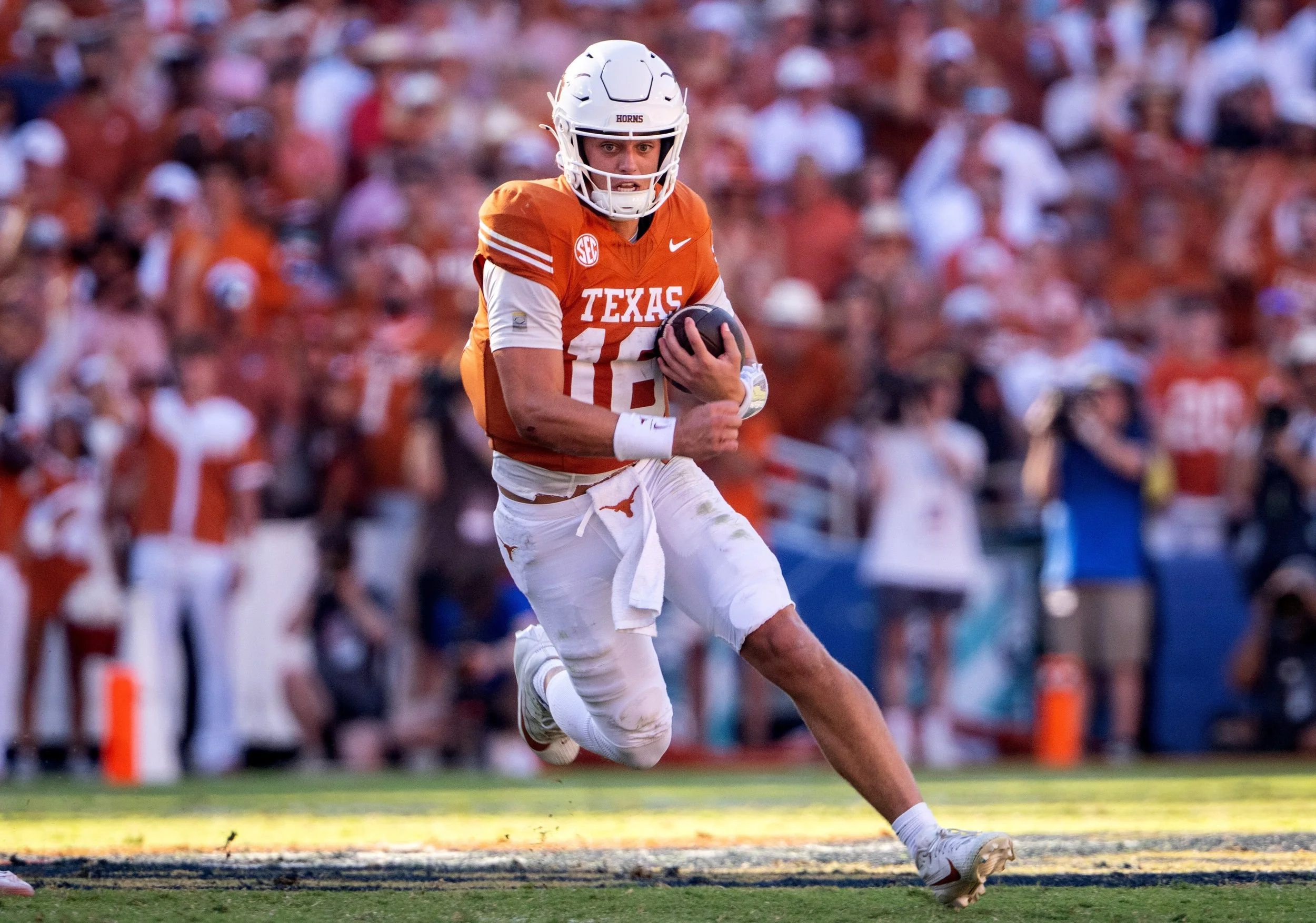
Texas quarterback Arch Manning runs upfield during the second half of an NCAA college football game against Oklahoma at the Cotton Bowl, Saturday, Oct. 11, 2025, in Dallas. Texas won 23-6. (AP Photo/Jeffrey McWhorter)
According to Pro Football Focus (PFF), his receivers have dropped nine passes. His adjusted completion percentage, which accounts for drops and removes certain uncatchable attempts, is 76.6%.
Those drops show that some of Texas’ passing struggles belong to the receivers, not Manning.
Still, Manning has not been equally effective in every situation.
Manning has completed nearly two-thirds of his throws from clean pockets, but that figure falls to 53.8% under pressure. He has taken 10 sacks through four games, six of them in his most recent outing at Tennessee. Nearly a quarter of his pressured dropbacks have ended in a sack.
Disrupting Manning can stop a possession without requiring Oklahoma to force a takeaway. But reaching him won’t be as simple as identifying a struggling offensive tackle.
Despite Manning’s 10 sacks, Texas’ offensive line has generally protected him well.
Dylan Sikorski has not allowed a pressure across 128 pass-blocking snaps. Trevor Goosby has surrendered seven pressures without allowing a sack, while Melvin Siani has allowed four pressures, including two sacks.
That success hasn’t carried over to the running game.
That difference has kept Texas from becoming as balanced as its personnel might suggest.
Hollywood Smothers and Raleek Brown have carried most of the rushing workload, combining for 394 yards and six touchdowns on 89 attempts.
Smothers has been the more effective runner after contact.
Of his 198 rushing yards, 141 have come after a defender reached him. He has forced 13 missed tackles, giving Texas a back capable of salvaging carries when the blocking does not create a clean opening.
Brown has handled more attempts and scored four touchdowns, but neither back has consistently been given room to run untouched.
Texas’ interior blocking helps explain why.
Sikorski, Brandon Baker and Connor Robertson have each earned run-blocking grades below 60 from PFF. Against Tennessee, the Longhorns’ team run-blocking grade fell to 48.7, their lowest of the season.
The same group that can give Manning time has not consistently moved defenders out of the way.
Nor has Texas built its rushing attack around designed quarterback runs.
Manning has gained 149 yards on 20 scrambles, with most of his rushing production coming when passing plays break down. That makes containing him another part of the equation for Oklahoma’s defense.
Covering his receivers will not finish the play if the pass rush leaves him an escape route.
But those receivers present the larger problem.
Ryan Wingo leads Texas with 19 catches for 239 yards and two touchdowns. The Longhorns have used him outside and from the slot, finding ways to involve him without asking Manning to repeatedly complete difficult throws downfield.
Wingo has caught all six of his short targets. Another six receptions have come on throws behind the line of scrimmage, where his speed has produced 71 yards after the catch.
Those easy completions put Wingo in space and force defenders to finish the tackle. Oklahoma has improved its tackling after struggling early this season, but Wingo will test whether that progress holds.
Cam Coleman provides a different threat.
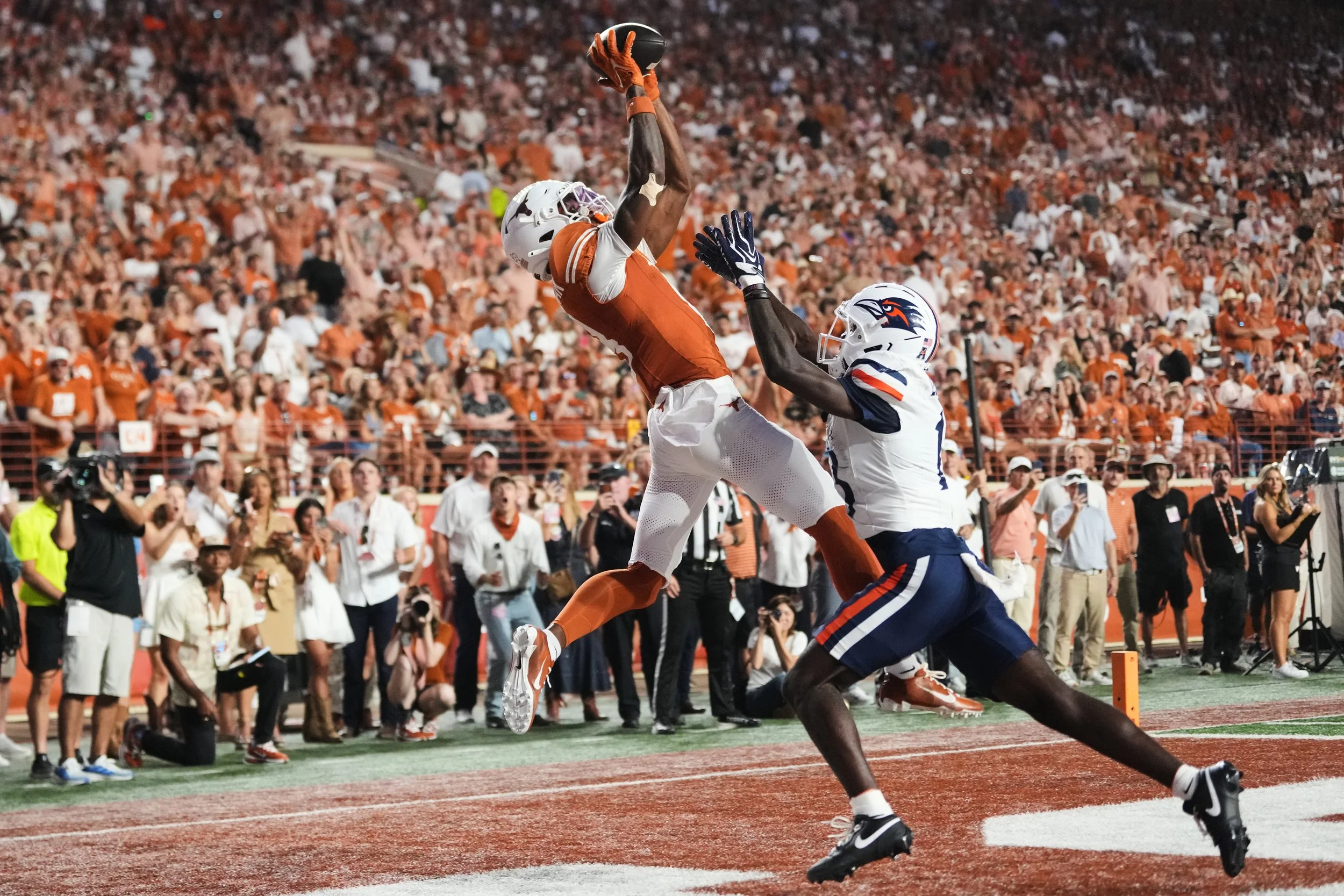
Texas wide receiver Cam Coleman, left, catches a touchdown pass as UTSA cornerback RJ Lester Jr., right, defends during the first half of an NCAA college football game in Austin, Texas, Saturday, Sept. 19, 2026. (AP Photo/Eric Gay)
Coleman has caught 12 passes for 208 yards and four touchdowns. Three of those scores have come on intermediate throws, where he has caught seven of eight targets.
While Wingo gives Texas ways to create after the catch, Coleman has done much of his work farther downfield. Only 28 of his receiving yards have come after the catch.
Together, they force a defense to account for both the immediate throw and the space behind it.
Emmett Mosley V adds another option from the slot, where he has played most of his passing snaps while producing 170 receiving yards.
Manning has been particularly effective attacking the intermediate middle of the field, completing 14 of 19 attempts for 229 yards.
Texas doesn’t need every deep shot to connect if they can keep finding those openings between the underneath defenders and safeties.
While the Longhorns’ offense has searched for consistency, their defense has found ways to disrupt opponents’ rhythm.
Colin Simmons leads that effort.
PFF has credited Simmons with 18 pressures and eight sacks through four games. He has produced seven of those sacks on true pass sets, when offenses can’t rely on screens, quick throws or play action to simplify protection.
That’s where Texas becomes particularly dangerous.
Simmons has repeatedly finished plays when opponents must drop back and throw. An Oklahoma offense still struggling to run the ball risks handing those opportunities to him.
But the Longhorns’ front does not depend on Simmons alone.
Lance Jackson has added 14 pressures, while Zina Umeozulu and Hero Kanu have each contributed eight. Maraad Watson has provided another seven from the interior.
Helping an offensive tackle against Simmons won’t remove the pressure coming from the rest of the line.
The group also has dependable run defenders.
Umeozulu has recorded seven stops against the run without missing a tackle. Ian Geffrard and Kanu have added strength inside, while linebacker Justin Cryer provides support behind them.
Simmons has been significantly better rushing the passer than defending the run. However, Texas has enough other contributors up front that attacking that difference will require Oklahoma’s offensive linemen to sustain their blocks.
Behind them, the secondary has generally limited the damage from completions.
Graceson Littleton has allowed 11 catches on 14 targets, but those receptions have produced only 75 yards. Kade Phillips has surrendered five catches for 38 yards.
Completing a pass against Texas does not necessarily mean creating a productive possession.
There is room underneath. Linebacker Rasheem Biles has allowed 15 receptions on 17 targets, and Cryer has surrendered eight catches for 81 yards.
But taking advantage of those openings requires patience, taking the available throw and keeping the next down manageable. John Mateer has struggled to do that consistently this season, and passing up an open receiver underneath gives Simmons more time to end the possession.
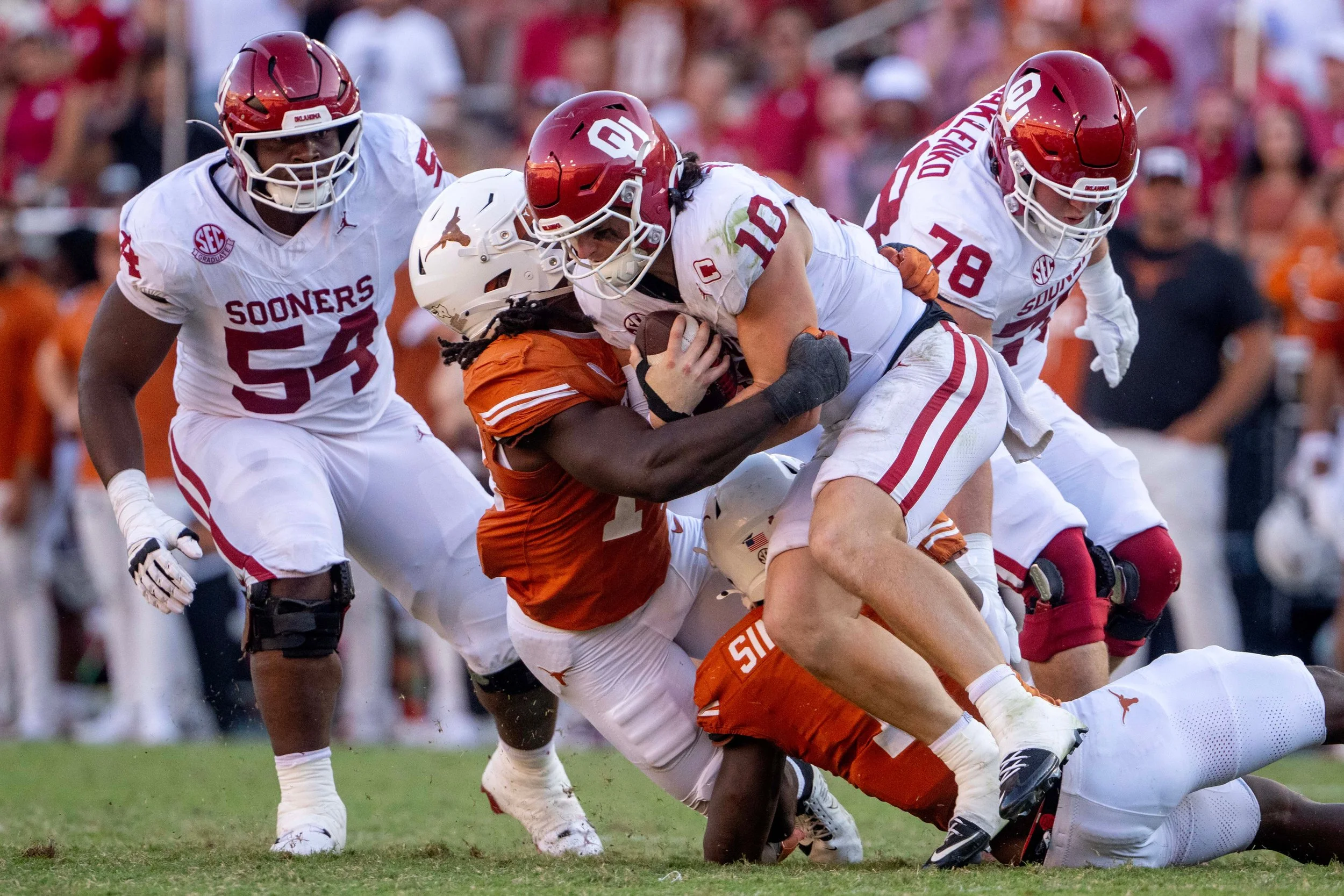
Oklahoma quarterback John Mateer (10) is sacked by Texas defensive end Brad Spence, center left, and defensive end Colin Simmons, bottom right, during the second half of an NCAA college football game Saturday, Oct. 11, 2025, in Dallas. (AP Photo/Jeffrey McWhorter)
Taken together, Texas’ first four games have revealed a team whose strengths can cover for its inconsistencies.
The running game hasn’t consistently controlled the line of scrimmage, and Manning has not avoided every mistake. Still, the protection gives him opportunities, Wingo and Coleman provide different ways to attack a defense, and Simmons gives Texas a player capable of ending a drive by himself.
Oklahoma has pieces capable of challenging that formula.
Its defensive front can test Texas’ run blocking and force Manning to operate without a dependable rushing attack. The Longhorns have also allowed enough underneath completions to give the Sooners’ offense opportunities to move the ball.
Texas has already shown it can win without everything running at full throttle.
Oklahoma must make those inconsistencies matter. Can the Sooners shut down the running game, pressure Manning without giving him room to escape and take the available throws before Simmons can reach Mateer?
Texas’ first four games have shown where those opportunities exist. Saturday will show whether Oklahoma can take advantage of them.