
Steve Curtis - Oklahoma’s Defense Must Take Away Texas’ Easy Answers
Steve Curtis | October 8th, 2026
Oklahoma’s defense left Athens with a result that didn’t tell the real story of its performance.
Georgia scored 41 points, but three separate Oklahoma turnovers helped produce 17 of them. One fumble was returned for a touchdown. Another gave the Bulldogs the ball at Oklahoma’s 11-yard line for an easy trip to the end zone. The third set Georgia up for a free field goal.
The Sooners’ defense held Georgia to 306 yards and three conversions on 12 third-down attempts while forcing two takeaways. Yet that resistance never became enough to keep Oklahoma in the game.
Saturday presents a different challenge.
Texas isn’t arriving at the Cotton Bowl with Georgia’s early rushing dominance. The Longhorns have instead reached 4-0 with solid pass protection, receivers who threaten different parts of the field and enough answers to survive difficult possessions.
Oklahoma’s defense must take those answers away.
The first opportunity comes against the run game.
Hollywood Smothers and Raleek Brown have combined for 394 yards and six touchdowns, but Texas hasn’t consistently cleared space for either back. Guards Dylan Sikorski and Brandon Baker and center Connor Robertson have each earned run-blocking grades below 60 from Pro Football Focus (PFF).
Against Tennessee, Texas’ team run-blocking grade fell to 48.7.
That gives Oklahoma’s interior a matchup it must win.
Jayden Jackson, David Stone and the rest of the defensive tackle rotation need to take control of the line of scrimmage, prevent Texas from creating movement and keep blockers from reaching the linebackers cleanly.
If Texas can turn its least dependable offensive area into a productive one, Arch Manning’s job becomes considerably easier.
But winning at the point of attack is only the beginning of the assignment.
Smothers has gained 141 of his 198 rushing yards after contact and forced 13 missed tackles. Texas doesn’t need to create a perfect opening if he can run through the defender waiting for him.
Oklahoma has improved its tackling since the early struggles against UTEP and Michigan, with the team tackling grade rising to 78.4 against Georgia, the highest of the season.
That progress must hold.
Kip Lewis and the other linebackers can’t allow a run bottled up near the line of scrimmage to bounce outside and become a gain that keeps Texas out of an obvious passing situation.
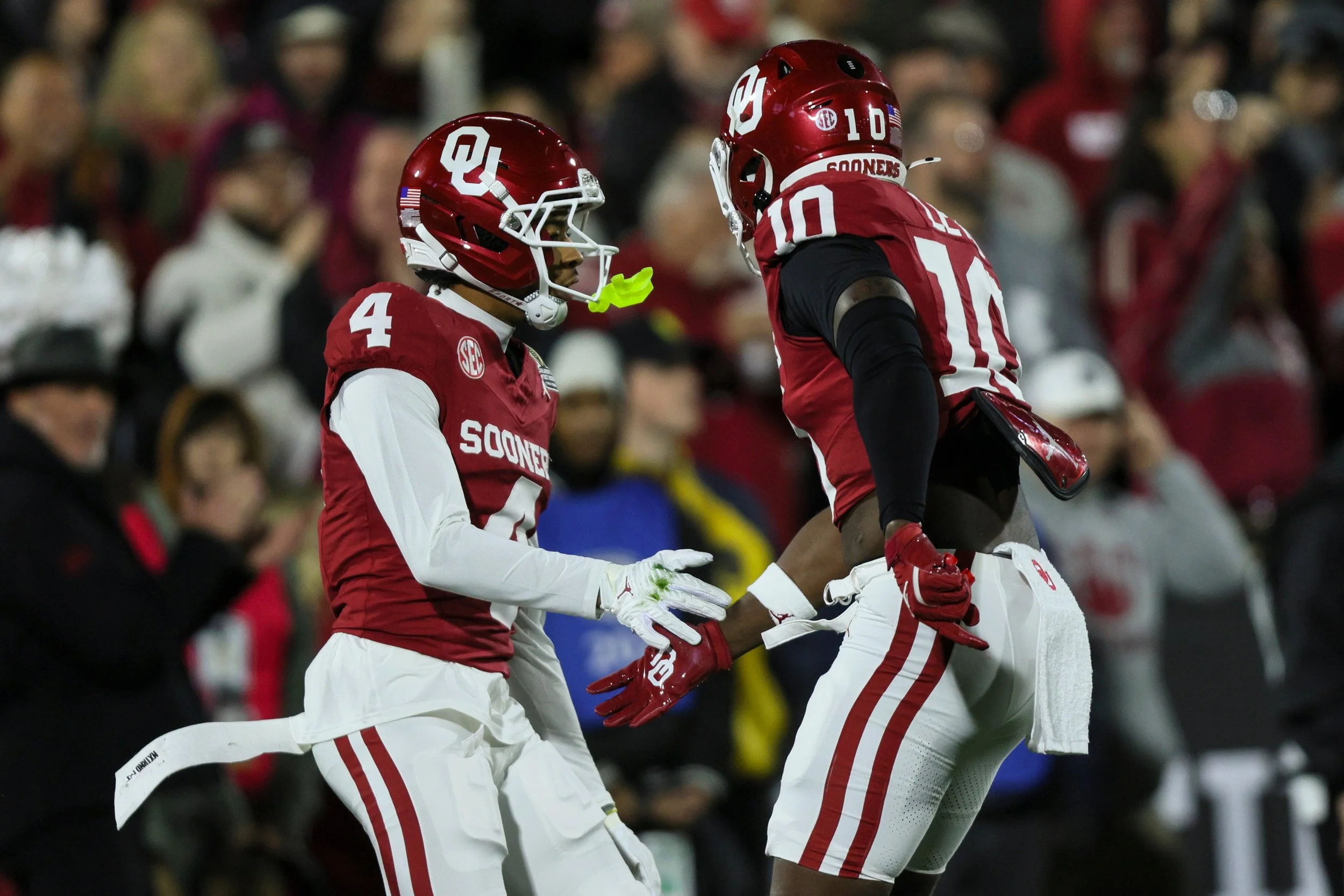
Oklahoma's Courtland Guillory (4) and Kip Lewis (10) celebrate a play against Alabama during the first half in the first round of an NCAA College Football Playoff, Friday, Dec. 19, 2025, in Norman, Okla. (AP Photo/Nate Billings)
Defensive ends Taylor Wein and Adepoju “PJ” Adebawore have an equally important responsibility outside.
They must keep the Texas backs from escaping the interior without widening the front so far that they create another lane inside. Wein has been one of Oklahoma’s most dependable run defenders, and this matchup requires that discipline before it requires a sack.
Stopping the backs would place more of the game on Manning.
That’s an opportunity, but it’s not a solution by itself.
Manning has completed 73 of 116 passes for 859 yards and seven touchdowns. His receivers have dropped nine passes, meaning his completion percentage understates how often he has given them a catchable ball.
Oklahoma can’t build its plan around Texas failing to finish those opportunities again.
The Sooners must make the throws more difficult.
Ryan Wingo creates the first problem underneath.
Texas has used Wingo outside and from the slot, getting him the ball quickly rather than requiring every reception to develop downfield. Six catches behind the line of scrimmage have produced 71 yards after the catch.
Those throws can neutralize a pass rush before it reaches Manning.
Courtland Guillory, Eli Bowen and Reggie Powers III must recognize where Wingo aligns, close without overrunning him and finish before the catch becomes an open-field race.
But crowding those throws creates room for Cam Coleman.
Coleman has caught seven of eight intermediate targets, with three of his four touchdowns coming on those throws. Emmett Mosley V provides another option from the slot.
Texas can attack the space behind defenders stepping forward to stop Wingo or the running backs.
That places the balance of the defense on its linebackers and safeties.
Owen Heinecke, Lewis and Powers can’t surrender the middle simply because Manning shows a handoff. Peyton Bowen must remain positioned to help against Coleman without allowing Texas’ shorter throws to pull him out of the deeper coverage.
Manning has completed 14 of 19 intermediate throws over the middle of the field for 229 yards.
That’s the area Oklahoma needs to make less comfortable.
Brent Venables can disguise the coverage and change which defender occupies Manning’s first passing lane, forcing him to move beyond the throw he expected before the snap. He has struggled at times this season when that first option disappears.
Then the pass rush has a chance to matter.
Texas has generally protected Manning well, but he has taken 10 sacks, including six in his most recent game at Tennessee. Nearly a quarter of his pressured dropbacks have ended in a sack.
The Sooners can disrupt possessions without needing a takeaway every time.
However, Wein, Adebawore and Oklahoma’s interior rushers must work together. Racing beyond Manning while another defender opens a lane through the middle could turn successful coverage into a scramble.
Manning has gained 149 yards on 20 scrambles.
Containing him is part of reaching him.
Oklahoma needs to close the pocket, make Manning hold the football and finish when the passing opportunity disappears. Sending additional pressure will only help if the coverage behind it prevents an immediate answer.
Each part of the assignment depends on the others.
Control Texas’ inconsistent run blocking. Finish against Smothers and Wingo. Protect the intermediate middle. Pressure Manning without giving him room to escape.
Oklahoma has the personnel to make the Longhorns sustain possessions through more difficult plays. It also has enough recent tackling progress to believe the first defender can end those plays.
But those strengths must appear together.
Stopping a back means little if Manning escapes on the next down. Closing the pocket means little if Coleman is already open behind the linebackers.
Texas has won close games because it has found another answer when one part of the offense stalls.
Saturday, Oklahoma’s defense must make that next answer harder to find.